Voice AI for Car Rental Companies: From Missed Calls to Confirmed Actions
Updated

The phone rings while two customers collect keys and another asks about a child seat. A caller wants to move an airport pickup after a delayed flight. Another needs to extend a rental. Which calls can an AI phone agent actually finish?
That question matters more than whether a system can answer at 10 p.m. A voice AI agent can collect a request immediately, but a customer needs to know whether the pickup time changed, the extension was approved, or help is on its way. Each outcome requires different access to the rental company's systems and a clear handoff when the agent cannot complete it.
The cover illustration was created for Lineshift and does not depict an actual deployment.
What can a car rental AI phone agent handle?
Start with three levels of service:
- Answer and inform. Give verified branch hours, pickup instructions, return procedures, document requirements, and directions from an approved knowledge base.
- Capture and route. Collect a caller's name, contact details, pickup and return locations, dates, vehicle class, and request. Create a task or lead for the right branch with a callback deadline.
- Check and act. After identifying the customer and consulting live systems, quote an available class and total price, place a reservation, modify a pickup, extend a rental, or initiate an approved assistance workflow. Only this level should tell a caller that the change is confirmed.
The third level depends on reliable system access, business rules, and transaction verification. A lead captured at night is an opportunity; it is not a booked car.
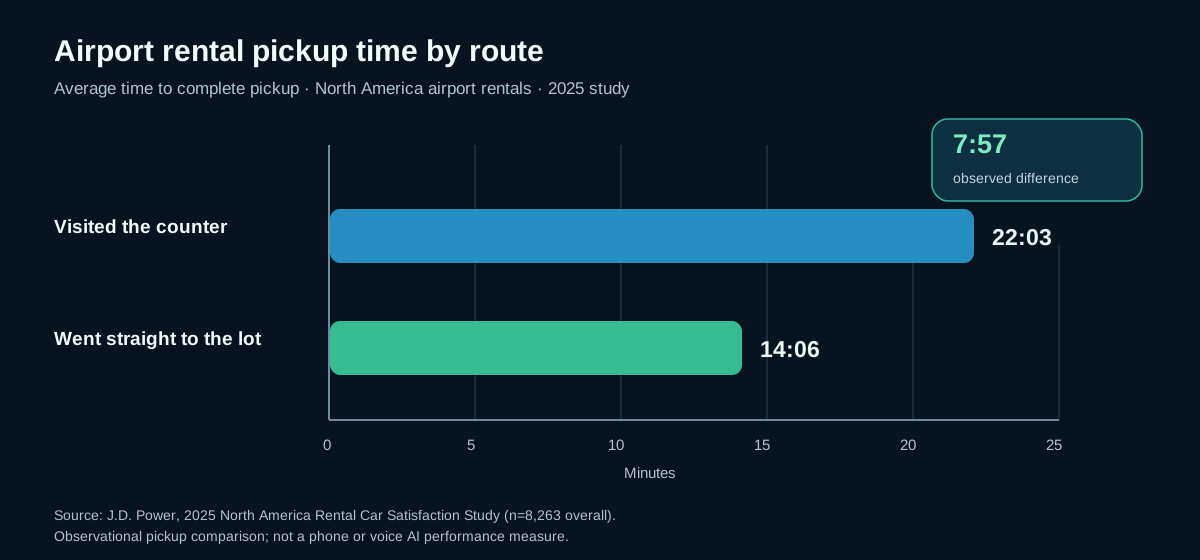
Counter time is also scarce. In J.D. Power's 2025 North America airport rental study, customers who visited the counter took an average of 22 minutes and 3 seconds to complete pickup, compared with 14 minutes and 6 seconds for those who went straight to the lot. This is an observed comparison of pickup routes, not evidence that AI phone answering reduces pickup time. It does show why a busy counter needs room to focus on customers already there.
A booking call is more than a date and a vehicle
Consider a traveler calling for a one-way rental after a delayed flight. The agent needs a pickup and return location, both times, a suitable vehicle class, the driver's age where it affects eligibility, and any requested equipment. It then needs to check actual inventory and branch rules. Before taking payment or confirming, it should present the applicable total, including material location and equipment charges, through an approved checkout flow.
The US Federal Trade Commission's car rental guide notes that drop-off locations, equipment, additional drivers, and age can affect charges. That is why a plausible daily rate from a static FAQ is not enough for a final quote. If live pricing or vehicle availability cannot be checked, the agent should offer to send a quote request to staff and say exactly when they will respond.
The same distinction applies to pickup changes. A caller may ask to collect a car at 10 a.m. instead of 8 a.m. The agent can record the new arrival time immediately, but it should confirm a revised reservation only after the booking system accepts the change and returns an updated reference. Policies vary by operator, country, booking channel, and prepaid status. Enterprise's France FAQ, for example, warns that changes can alter rates and that some third-party bookings must be changed through the original seller. The example illustrates the integration and policy checks an operator needs; it is not a rule for every rental company.
Extensions and returns need contract-aware answers
An in-rental extension is a different transaction from moving a future pickup. The vehicle may already be promised to another customer, the rate may change, and an additional card authorization may be necessary. Enterprise's US extension guidance explicitly tells customers to call and describes additional authorization and possible rate changes. Other fleets may allow changes in an app. An AI agent must follow the policy of the specific rental company it represents.
A practical extension flow is to identify the rental agreement, check the requested return time against vehicle availability and company rules, calculate the revised terms, obtain any required approval or payment authorization, and write the change back to the contract. If any step fails, create a priority callback rather than implying that the renter can keep the car longer.
For returns, an after-hours key drop may be allowed at one branch but unavailable at another. An agent should use current branch instructions and avoid promising that a vehicle has been checked in before the fleet system records it.
What happens when the car breaks down?
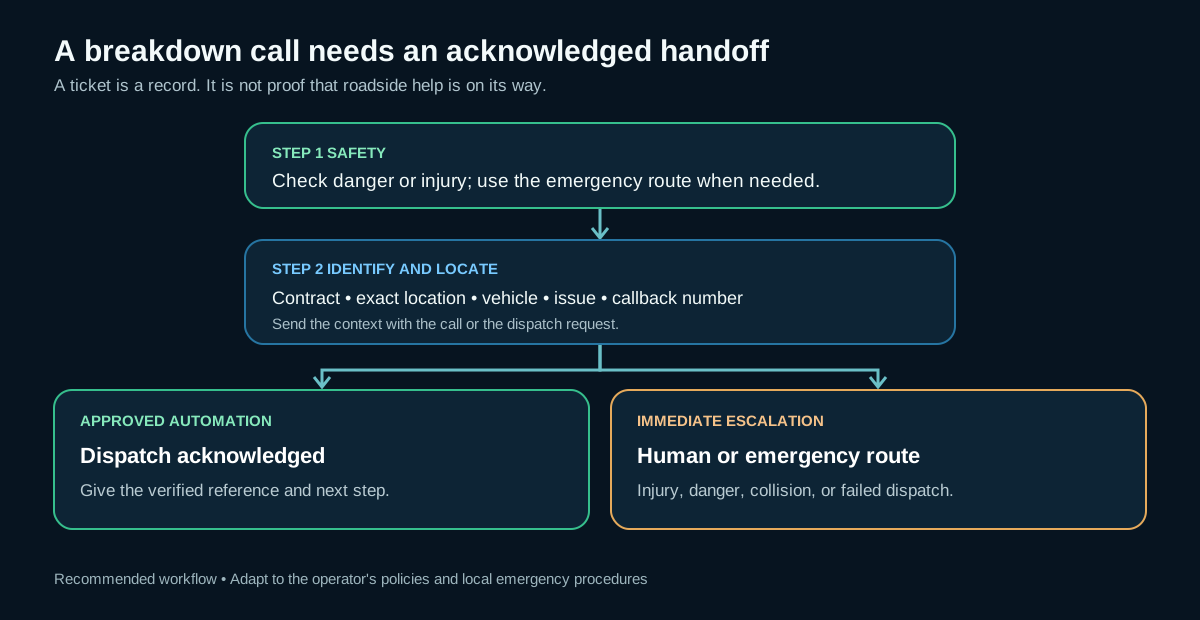
Safety comes first. A caller with an immobile car should be directed to get to a safe location and use local emergency services when there is immediate danger. The AI can collect the rental agreement, callback number, exact location, vehicle details, and description of the problem. It should then transfer or dispatch according to the rental company's roadside procedure, with the details attached so the caller does not start over.
Hertz's US breakdown guidance asks for the agreement number, exact location, vehicle details, problem description, and contact number. Enterprise directs US renters with a non-drivable mechanical breakdown to a safe location and its roadside line. These examples explain why an assistance call needs a dedicated route and accurate location capture.
An agent that files a ticket has documented the incident. It has not dispatched a truck unless the roadside system acknowledges the job. If the caller reports an injury, collision, unsafe location, uncertainty about coverage, or a failed dispatch, hand off to a trained human or the emergency process immediately. Provide a clear status: “I have sent your details to roadside assistance,” only when that action actually happened.
Where should the human team take over?
Good routing is part of the service, not a sign of failure. A staff member should handle disputed damage or charges, complaints, compensation, ambiguous identification, unusual insurance questions, suspected fraud, and situations where a replacement car must be negotiated across branches. A live transfer should carry the caller's verified identity, request, contract or reservation reference, steps already attempted, and urgency. If no one is available, the agent should log an assigned callback with a deadline and tell the caller what will happen next.
This split can free counter staff for vehicle handovers and complex conversations. It also gives managers a precise way to evaluate the agent: what proportion of calls were answered, captured, confirmed, transferred with context, or left unresolved? A call can count as “handled” while still leaving the customer without a changed reservation.
How to evaluate voice AI for a rental fleet
Run a short pilot on a few branches and call types before broad rollout. Pick scenarios with clear answers, such as hours, arrival instructions, and quote requests. Then add read-only reservation lookups, controlled changes, and roadside routing when the relevant systems and owners are ready.
See Lineshift for rental operations to follow a pickup-change request from capture through system acknowledgment or branch follow-up.
For each call type, document the required data, permitted action, source system, confirmation signal, and escalation owner. Measure the same outcomes before and after launch:
- Answered calls by hour and branch: Did after-hours and peak-time coverage change?
- Qualified inquiries and confirmed bookings: Did captured interest become a real reservation?
- Successfully modified contracts: Were requested changes actually committed?
- Roadside dispatch acknowledgments: Was help initiated, beyond creating a ticket?
- Escalation and callback completion: Did unfinished calls reach a person in time?
- Recontacts and corrections: Did apparently resolved calls create downstream work?
For economics, compare the incremental contribution from bookings that would otherwise have been missed and the staff time actually saved with subscription, call, implementation, and integration costs. Do not value every answered call as a new booking. Separate an uplift in answer rate from an uplift in confirmed reservations, and review exceptions manually during the pilot.
The right starting question is specific: Which calls can we answer accurately today, which actions can our systems confirm, and who owns the rest? Once those three questions have clear answers, a rental company can expand phone coverage without making promises its operation cannot keep.
Want to test these flows against your branches? Explore Lineshift for car rental companies and bring a booking, in-rental, or assistance call to a custom demo.