CONNECT Distribution 2026: profitability tops the agenda, with AI as a lever

9 November 2026 · Lineshift
New Chinese brands, fuel costs, a changing after-sales business: dealer groups must adapt their model while protecting their margins. In Deauville, our takeaways from CONNECT Distribution 2026 come back to one very practical question: how do you do more with less by freeing teams from time-consuming tasks? AI opens up options, provided it is connected to the dealership’s tools and data.
Held on 5 and 6 November at the Hôtel Royal Barrière, this edition of CONNECT Distribution, Auto Infos’s annual event, covered distribution costs, used-vehicle performance, after-sales and artificial intelligence. For executives who couldn’t attend, here is our reading of the priorities to bring back to the leadership team, supplemented with external benchmarks on the French market.
Three pressures forcing dealer groups to rebalance
Chinese brands are changing the competitive landscape
Their presence is now tangible. According to an analysis published by Le Journal de l’Automobile on 1 October 2026, Chinese brands accounted for 8% of new-car registrations in France in September 2026, compared with 5.8% over the first nine months of the year. The two periods should be kept apart: the monthly figure shows acceleration, not a secured annual share.
For dealers, this arrival creates opportunities for new franchise agreements as well as additional competitive pressure. It also raises questions of investment, training and organisation: how do you add new brands while maintaining execution quality and the profitability of each site? Taking on more brands requires an organisation that can keep up.
Fuel prices sharpen the trade-offs on combustion vehicles
Energy prices weigh on drivers’ running costs. On 3 September 2026, the French government reported a renewed rise in fuel prices, extending support for the hardest-hit sectors and high-mileage drivers.
For a dealership, our reading is this: the pressure brings running costs further into the sales conversation. It can make some combustion models harder to sell and shift what customers look for. Its effect, however, depends on the vehicle, the mileage and access to charging; on its own, it does not point to a uniform drop in combustion-vehicle sales.
That makes it all the more useful to qualify needs carefully, explain costs and follow up with prospects over time. This work takes sales time, which has to be freed up elsewhere.
Electrification is reshaping service revenue, and it needs planning
The third topic touches a pillar of the dealership model: after-sales. A fully electric vehicle generally needs less routine maintenance than a combustion one: fewer moving parts, no engine oil changes and less brake wear thanks to regenerative braking. The US Department of Energy details these technical differences. This distinction should not be extended to hybrids, which keep a combustion engine.
For networks, this puts pressure on the potential of some recurring jobs as the vehicle parc electrifies. ANFA, in its maintenance study published in October 2023, identifies this shift while highlighting the cushioning effect of an ageing vehicle parc. Its 2026 barometer notes that the transition of vehicles on the road remains gradual and calls for new skills.
The task, then, is to anticipate changes in the business mix and in margin per vehicle. This does not mean every group is already seeing lower after-sales revenue. Tyres, diagnostics, batteries and repairs continue to generate demand, with different economics from traditional combustion-engine servicing.
Doing more with less: reclaiming time spent on repetitive tasks
These changes make it even more important to use the group’s resources well. Looking up information across several systems, re-keying a customer record, writing up a report or manually chasing a prospect all take up team time. Added together, they reduce availability to advise a buyer, negotiate a trade-in or explain a repair.
AI can take on some of these tasks: capturing a request, preparing a summary, finding information or triggering a follow-up within defined rules. The gain should show up in daily work: less re-keying, fewer forgotten requests and staff more available for situations that need their expertise.
The experience shared by Benoit Gicquel, Marketing and IT Director at DBF Automobiles, scheduled for the session on AI-driven lead handling, brings a dealer group’s perspective to this topic. The operational question to keep in mind: does the time saved at first contact actually reach the salesperson, with a usable history and a clear handover?
The Lineshift keynote: from conversation to action
The Lineshift keynote, on dealership profitability in 2027, turned this search for productivity into concrete demonstrations. Its central idea: AI that answers is good. AI that acts is better.
Answering a call is a first step. The value grows when the agent can understand the request, look up business information and carry out a useful operation: send a vehicle sheet, prepare an appointment or pass a qualified request to the right person.
One scenario illustrates this move to action: a used vehicle matching a customer’s search arrives in stock. An automation identifies the relevant prospects, then an agent can reach out, talk with the customer, send the vehicle sheet and offer a test drive. Contact rules, vehicle availability and reservation terms must be checked throughout.
With Lineshift Action, this approach extends to staff: an assistant connected to business tools, and automations triggered by an event or a deadline. Looking up information or preparing follow-ups can then take up less of their day, leaving more room for advice and customer relationships.
Return on investment still has to be measured on a specific scope, taking into account the cost of the solution, its integration and ongoing management. AI is a lever for efficiency; its gains depend on the process chosen and on team adoption.
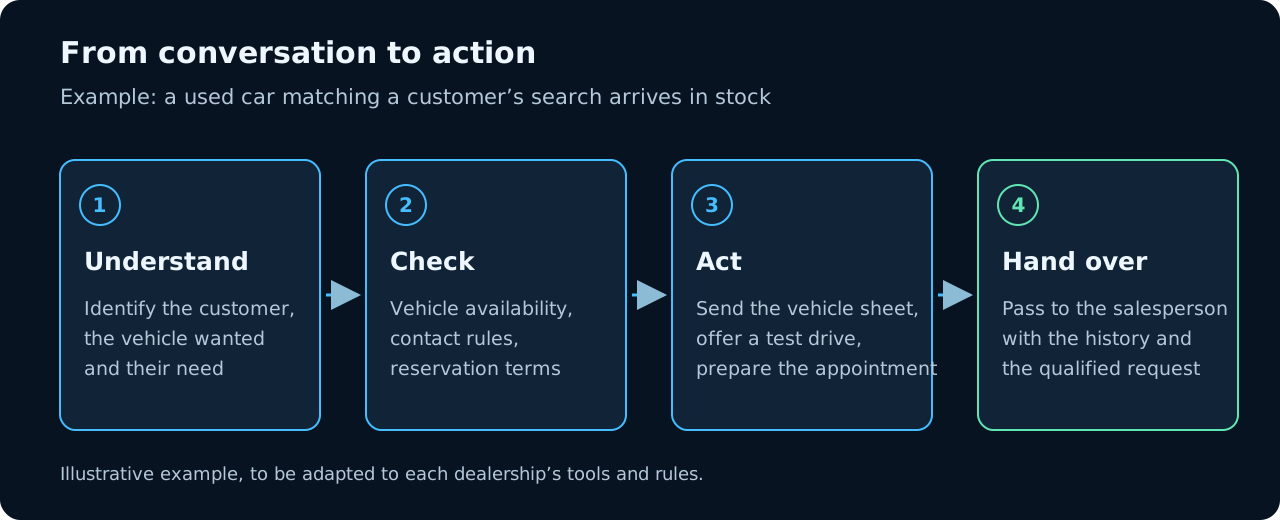
Illustrative example: understand, check, act and hand over to a person.
Getting there requires data that can flow
An assistant that makes staff copy information between several screens leaves much of the work untouched. To reduce time-consuming tasks, you have to connect the systems that hold the data and where work gets done: CRM, DMS, inventory, scheduling, telephony and messaging.
David Pilo, co-founder and CEO of Walcu, stressed the need for data to flow in his talk on the Data Act. The topic ties directly to productivity: information available in the right place avoids a search or re-keying and keeps the customer journey moving.
The Data Act, as presented by the European Commission, notably governs access to data from connected products and switching between data processing service providers. It does not create automatic access to all data in every system. Rights, permissions and personal data protection still have to be assessed case by case.
For leadership, the implications are practical: check available interfaces, export formats, access rights and portability commitments. The ability to connect your tools and move your data should be part of choosing a vendor.
Used vehicles and after-sales: protecting every margin opportunity
Sessions on digital used-vehicle strategy, residual values and cost control round out this picture. Performance depends on the whole journey: stock visibility, lead handling, appointments, turnover and margin.
In after-sales, also on Friday’s programme, efficiency comes from better-prepared requests and handovers. Automating information gathering or scheduling a callback can reduce interruptions. The team keeps sign-off on commitments that depend on its capacity, parts and diagnosis.
The goal is to reclaim useful time while making service more reliable. A call that gets handled or a better-prepared file counts when it genuinely helps the team deal with a request and helps the customer move forward.
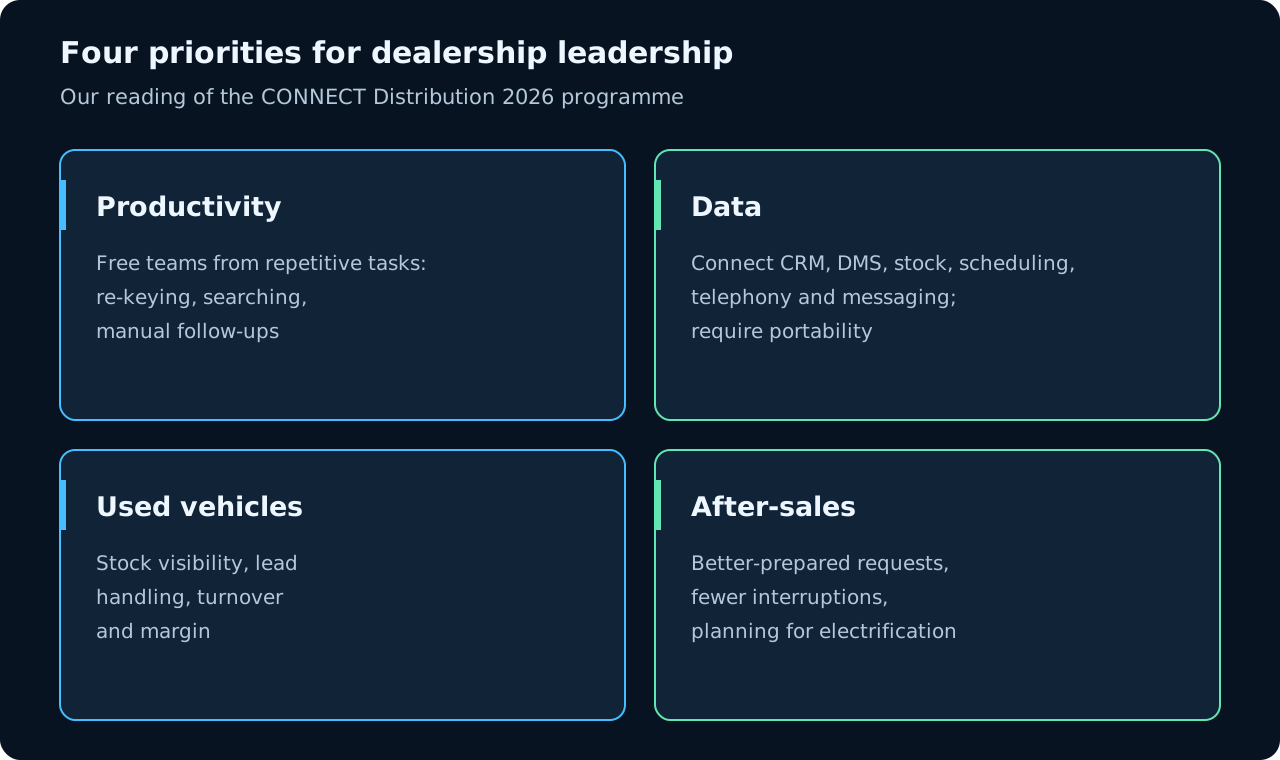
Our reading of the programme topics and what they mean for executives.
Three decisions to take back to the leadership team
- Identify one source of lost time or missed revenue. Pick a specific journey: service requests, used-vehicle follow-up or prospect qualification.
- Check connections and responsibilities. Define the data needed, the access permitted and the point at which a person takes over.
- Measure the financial and operational result. Track the time actually freed up, appointments kept, costs and service quality, against a documented baseline.
Thanks to the Auto Infos and Infopro Digital teams, the speakers and the dealers for these discussions. To build on the topics raised in Deauville, bringing together the people responsible for one customer journey and identifying its main friction points is a concrete first step towards a useful pilot.